Notes from Innovation in Music 2024 conference, Oslo
Pretty much every conference I’ve attended I’ve found inspiring and motivating. It’s like sitting down and reading a whole pile of papers over a weekend, on disparate and unusual topics, often with some suprising stuff. InMus24 was no exception. I heard presentations on the social history of drum machines; intuition in the process of mastering audio; grammatical analysis of Ace of Bass lyrics; and plenty more. Below are a couple of things that stood out to me as particularly interesting.
Peter Vuust’s paper on the psychology of perception in music, Groove on the Brain, was a great start to the conference. I was familiar with some of the ideas from the Groove Workshop conference I attended last year, organised by Maria Witek who’s an expert in the field. Particularly, the notion that there’s a sweet spot on the spectrum between simple metronomic rhythm and complex syncopation, which follows an inverted u-shaped curve, and that it correlates to the types of rhythms that make listeners want to move, dance, and enjoy getting into the groove. To some degree it feels like common sense – that predictable patterns are too boring, and chaotic non-rhythm is too complex – but it’s interesting to see results from scientifically conducted studies that back it up. As an artist there’s no need to adhere to these rules, and there’s nothing to say that what might be considered objectively ‘groovier’ music is in any way better or worse. I’m interested in this as something to potentially play with or push against – playing with the level of complexity of rhythm, timing variations, loss of synchrony. Other areas of the keynote talked about the way people’s brains work in predicting rhythm, expectations of repetition and difference, counting off patterns of beats and how that effects perception – all of which I feel can inform new ideas for pieces of music.
Innovation being the foundation of the conference, there were several technical papers which gave me further food for thought. Jan-Olof Gullo discussed microphones, placement and approaches to recording live sound. In a slightly cruel trick he played two recordings and asked for feedback on the sound, telling us that the second was recorded with a certain fancy stereo microphone. On receiving some typically subjective descriptions of the second sounding more full, clearer or detailed (to paraphrase), he revealed the second was actually recorded with a pair of cheap and popular vocal mics, revealing how difficult it is to really tell what sounds good and what doesn’t. Did the second piece actually sound better or did the new information trick us into thinking so? There’s something there about acousmatic music and Schaeffer’s reduced listening – it’s impossible for sound to be heard without context, and even false contextual information can change what we think we hear. A theme running through several of the papers was around trusting intuition, trusting our hearing, ignoring technically ‘correct’ approaches in favour of a better sound. All very much things I try to implement in my own practice, and refreshing to hear from people with decades of technical experience and expertise, who I might otherwise have expected to have a stricter adherence to conventional practices.
The title of Ingvild Koksvik’s paper particularly intrigued me: Exploring the Unsayable Aspects of Musical Ideas in Record Production. Many of the sessions took place in a multichannel playback setup, and focused on Dolby Atmos recordings and techniques. My practice could not really be more different from Ingvild’s: I’m not interested in surround/immersive/multichannel audio, I don’t write ‘songs’ as such, I prefer making single take live dubs to more considered multitrack recordings, and my music is generally quite noisy and messy by design. I was intrigued by the idea of the unsayable, which seemed to be something like the vibe or feel of a song, in the way Ingvild described it – the spirit of the music, the intention of the song. The way I work, setting out to make a piece tends to have a fairly loose intention, only the kernel of an idea about form and structure, and I try and uncover or tease out the ‘spirit’ of the piece rather than impose it on what I’m making. But recognising what is working, how to facilitate that spirit, and narrowing down towards an intention is fundamental to my practice. Ingvild introduced Joel Hamilton’s notion of the aesthetic compass as something that can guide us towards the final finished piece. I think perhaps the difference in our approach, really, is that I don’t start out on the journey with a map or a particular direction in mind.
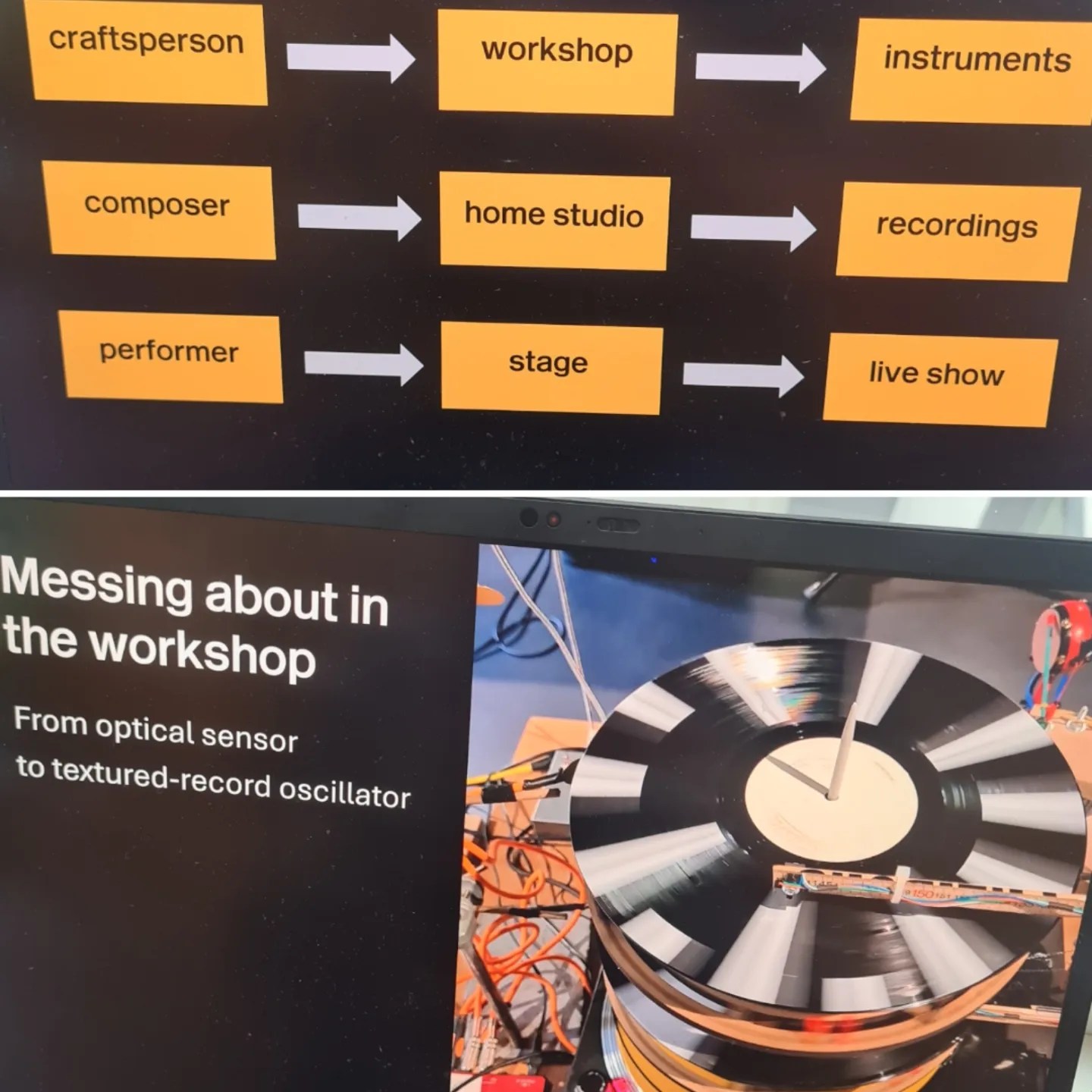
In my own paper I talked about using ‘messing about’ as a process for creative projects, in making instruments and devices as well as when performing or recording. I was pleased that there were resonances and points of connection with plenty of the other presenters (one paper on the creative use of distortion even quoted the same line from an article I quoted from), and had some good chats with folks about some of the ideas afterwards.
There’s loads more I could write about from InMusic24, and perhaps I will at some point. The past few months have been pretty hectic, which is why this is my first blog post in a while. I’ve spent some time writing papers and conference submissions, making some new things in the workshop, and playing gigs in Birmingham and Berlin. Things with hard deadlines that all happened a bit too close to one another. I’m looking forward to a bit more of a balance schedule the next few weeks, and hopefully the capacity to post here a bit more often again.
 Graham Dunning