Radio show selections: Splinter Orchestra and Plain Music Compilation
Notes on a couple of the pieces from this month’s radio show, episode 215 of Fractal Meat on a Spongy Bone.
I came across Splinter Orchestra via an essay by one of the group’s members, Jim Denley, in the excellent book The Aesthetics of Imperfection in Music and the Arts. I was struck by several aspects of the large ensemble improvising group’s approach. In particular the type of performance-to-microphone, using group improvisation and movement as a way of generating recorded compositions, as given in the description of a piece called “Spoke”.
“forming a circle around two omnidirectional mics situated either side of a mid-point, and that rather than rotate we move in our own time – in and out along a radius as if down the spokes of a wheel, towards and then away from the mics.”
What appeals to me is the use of physicality as a way of controlling the intensity and presence of each instrument. Like volume automation controlled by spatial distance. Since teaching some basics of field recording and live sound capture, I think about sound dispersal and microphone placement a lot – awareness of the inverse square law (meaning proximity to a speaker/microphone potentially has significantly more effect than common sense might suggest) helps consider how close and distant sound sources might appear in the ‘flattened’ mix that the microphone recording captures.
I generally enjoy hearing about artists’ self-imposed rules, manifestos and their justifications of them. I’ve been thinking about tuning systems recently, having just designed a turntable sequencer interface which can output discrete notes, and needing to make decisions about what those notes should be. (At the moment the module sets a low and high frequency, and divides the remaining tone space into equal segments – a reconfigurable scale which, with the combination of analogue inputs and digital processing, is likely different each time.) It’s refreshing to hear a group discuss their choice, especially in such a joyous and unapologetic way: “Splinter never tunes. … We’ve no formal agreement about systems of tonal organisation – we plunge into a seething-frequency sea without lifejjackets.”
The piece I’ve chosen for the radio show is First Tutti from the orchestra’s eponymous debut release as a 17 piece ensemble, which at times exemplifies this seething-frequency sea.
The new Plain Music compilation released by Japanese label tokinogake proposes to be a compilation of “works that are not in audio form”. It might be a challenge, then, to do them justice on the radio. I hope that playing some of these pieces without context doesn’t detract from the artists’ intentions.
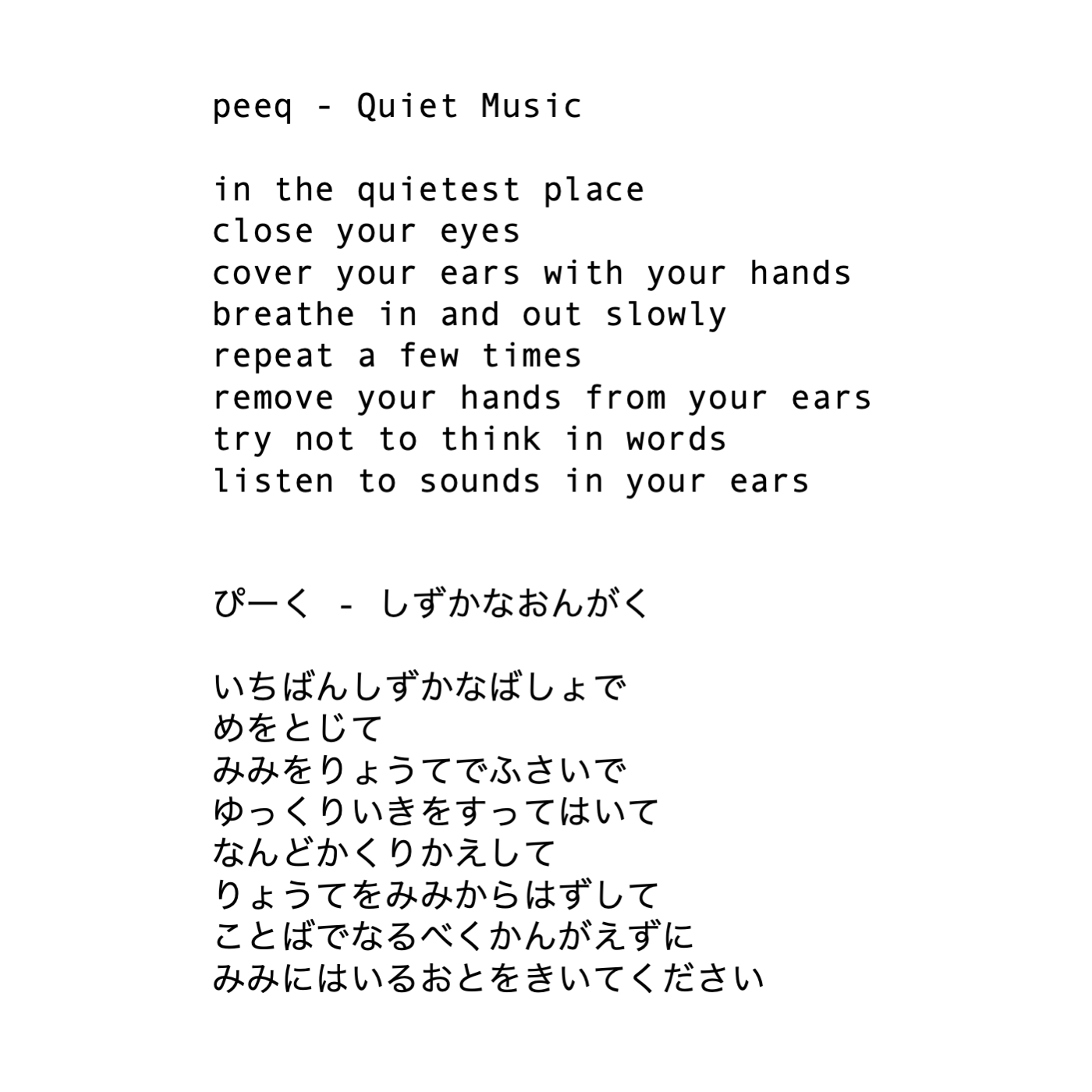
The large (25 track) compilation comes with a zip file of documents, midi files, SuperCollider patches, illustrations and video clips to explain process and allow listeners to implement some of them themselves. There’s lots of computer music in here, as well as some more hands-on work like nnirror’s drone piece with a self-explanatory title: microcassette motor & AC power brick surrounding an inductor (a video of which, if further evidence of process is required, comes with the download). I enjoyed the diversity in the ways people had responded to the theme – with some pieces only presented as text scores, such as peeq’s Quiet Music (below). As is often the way with big compilations of interesting stuff, I’ve added a bunch of the pieces to my bank of tracks for forthcoming shows.
 Graham Dunning