Approaches to Remixing
A label approached me recently to do a remix for one of their artists. It’s got me thinking about the different approaches it’s possible to take, and considering what I might do for this one. The first stage, of course, is listening through to the original artist’s tracks to see what might work. So whilst doing that I thought I’d revisit some of the methods I’ve used in the past. I’ve grouped the tracks into three broad-brush approaches: physical remixing, live code remixes and triggered-sound mixdowns.
Physical remixes, as I’m calling them, use physicality in two ways. First, taking either the physical artefact which makes up the release (typically a record) or copying sonic elements of the track onto physical media (tapes or dubplates). And second, applying a musical process where physicality plays a role in the outcome. Making music with Mechanical Techno that physicality is obvious, but as well as the contraption itself I mean my physicality in mixing it down: the hands-on playing on the mixing desk, effects and other technical components.
Colin Webster – Katepistemum (Graham Dunning Remix)
The first physical remix I did was for saxophonist Colin Webster for his set of solo recordings, Antennae. My approach here was to record snippets from the original piece onto cassette tape loops, each probably around a second in duration, but none of them of identical length. With eight tapes in total, each with both sides recorded, I then recorded a live mixdown combining them playing back on multiple tape players. Mostly leaving them to run, sometimes turning tapes over (for the other loop on the other side). Partially following Reich’s Process Music model, but with minor interventions to adjust which layers are present. The resulting piece adds as much tape hiss as there are saxophone sounds.
Michael Forrest – Computer Screen (Graham Dunning Mechanical Techno remix)
Michael Forrest’s track which I remixed was musically very different: an upbeat electronic pop tune with a vocoder chorus, layered synths, electronic percussion and sung vocals. My plan from the outset was to follow the then-developing self-imposed rules of Mechanical Techno, which meant I needed to get the stems into the playable hardware space as much as I could. I got a dubplate cut with sounds from the original piece, recording a few minutes of each at 133.333 bpm so I could effectively use them for force-locked grooves on the turntable. The verse vocals were more difficult, so I used a smartphone-based sample playback app and loaded each verse onto a different button, feeding them through effects pedals and a synth filter into the mix.
Michael filmed the video, like the previous demonstration video we made together. Similarly to that process, I hadn’t actually ‘written’ the music we were filming till the filming was happening. The whole thing was done in one session: building the machine, setting up the video, and mixing down the remix live. In hindsight it’s much longer than it should have been. With practice I’ve got better at making tunes change shape more quickly. I didn’t want to edit the take in any way, it was important at the time that it be entirely structurally consistent.
Sculpture: Projected Reworks. Graham Dunning – Grill
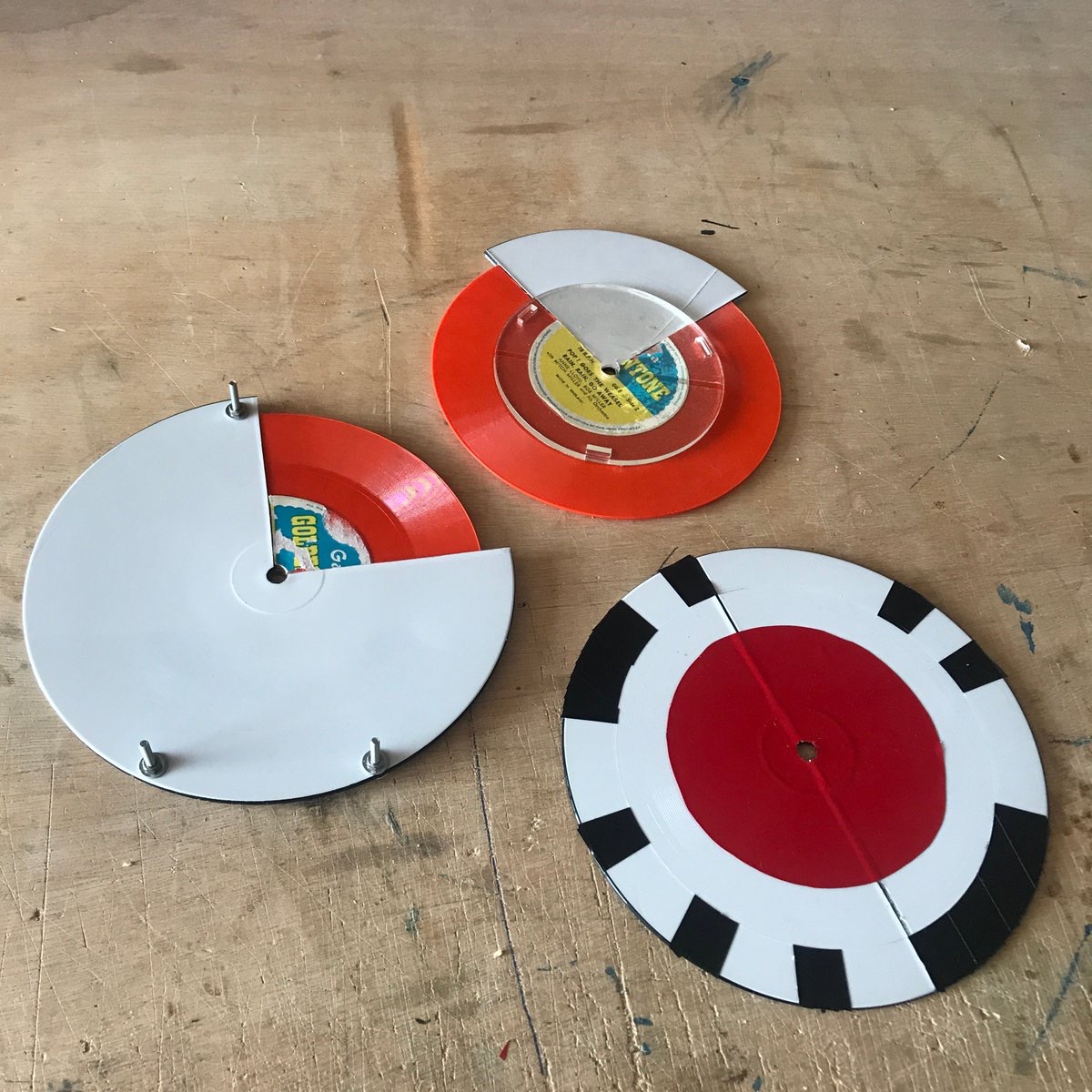
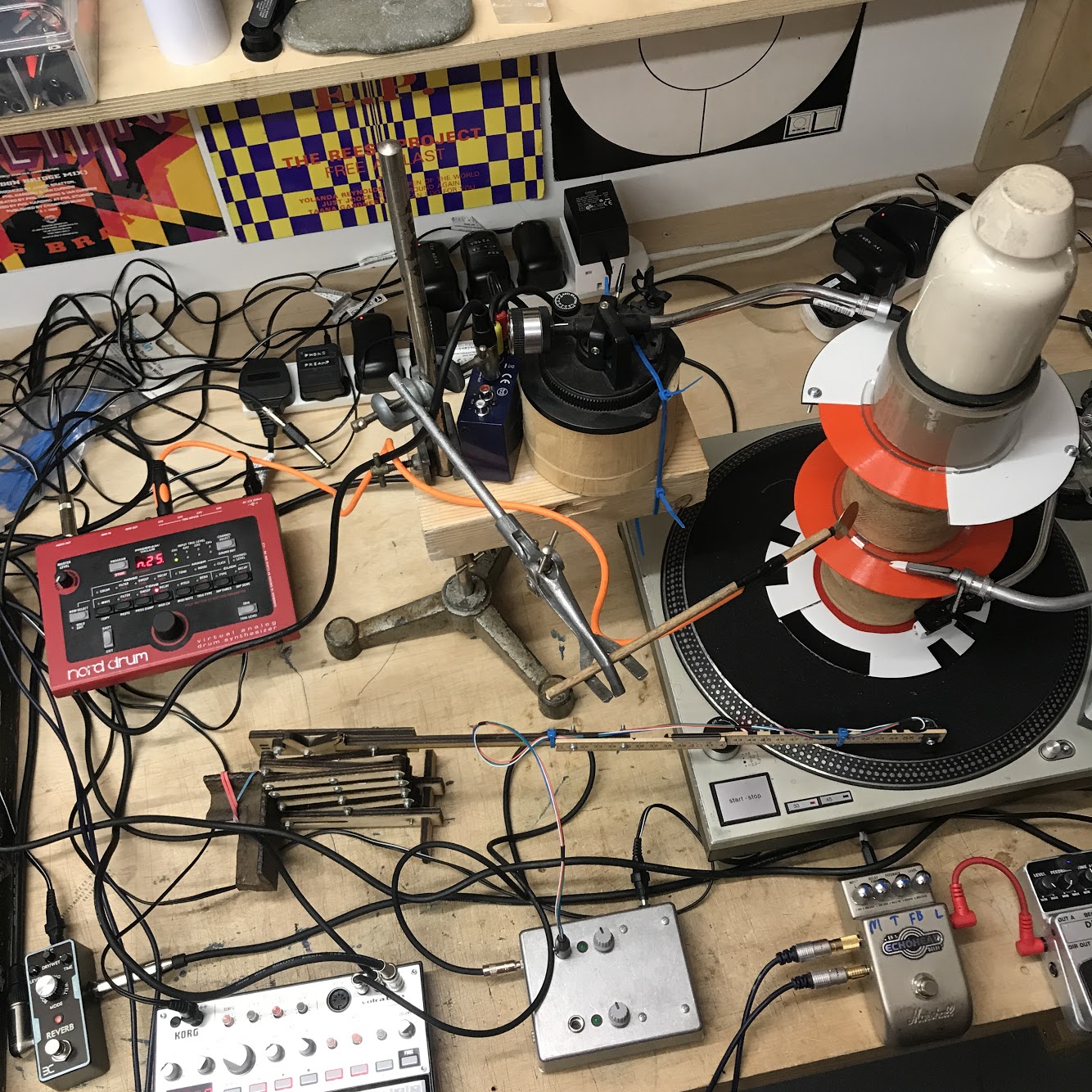
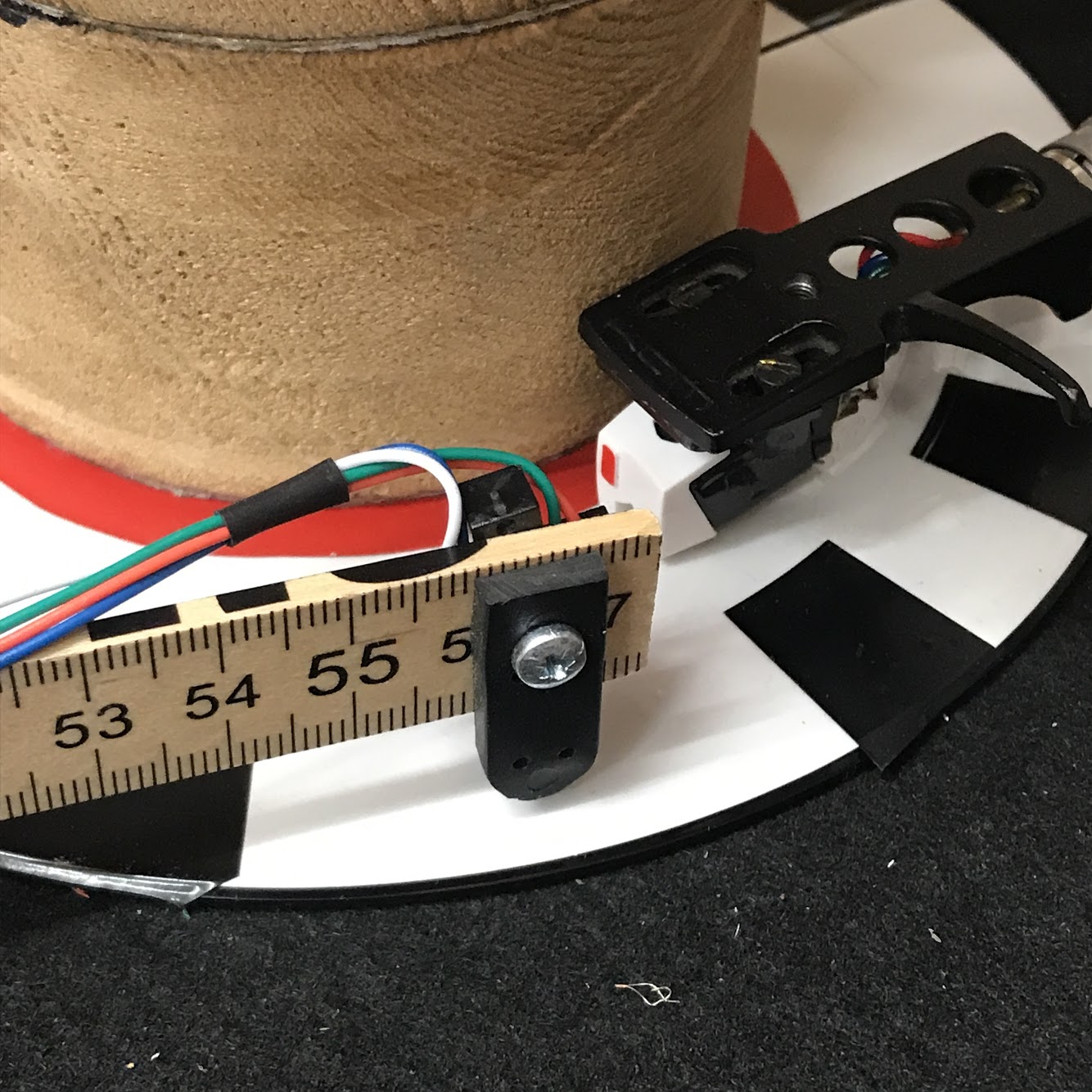
My remix for Sculpture was a lot more open-ended to begin with, as the release consisted of a five-inch picture disc with several locked grooves on each side. That is, there wasn’t really a ‘song’ to remix as such. I was given two copies of the disc, pre-picture adding, and at seven-inch size not five-inch. Some odd objects really. I made three hybrid discs from these (pictured), for use with the various interfaces from the Mechanical Techno setup. One disc I cut in half, flipped one section and re-stuck, adding some black stickers to the blank (non-etched) outer rim to use with the optical reflection sensor. The other I cut a quarter from and matched that with a chopped up 1950s children’s music disc (in fetching orange colour), adding pegs to one of the discs to trigger drum sounds. For the remix itself I played all three records simultaneously on a tower, with a tone arm on each record, optical sensor for a Volca Bass clock and triggers for drum sounds. The output was a live mixdown, with quite a lot of sound from the original Sculpture locked grooves.
Ore – Test Press Remixes. Graham Dunning – Skarn
To make a remix for Ore I followed a similar, if less destructive path, with forced-locked-grooves set up with multiple tone-arms on the test pressing version of the album. The initial impetus for the Mechanical Techno project was the inherent rhythm of the single-cycle-loop, and this piece foregrounds that with a half-time head-nodding beat and layers of drone.
Bangsing – I Kadek Tunas Sanjaya (Graham Dunning Remix)
I’ve also done a couple of remixes without using physical materials or hardware at all, both with the live coding program TidalCycles. For Indonesian label Insitu Recordings I remixed Bangsing’s track I Kadek Tunas Sanjaya, a recording of live-played gamelan. I sampled individual notes from the original recording an made a new set of sequenced patterns in the program, loosely following the structure and pacing of the original.
Graham Dunning vs THAT CLOUD – There’s another one, careful
For the Rental Yields project by Manchester Label Front & Follow I was paired with That Cloud and invited to remix several stems of noise, plunderphonics and instrumental recordings. I chose to use the material fairly blindly, programming essentially a series of rhythmical gates and allowing the randomness of the selection of different segments of the stems to guide the shape of the piece. There are no additional sounds but a lot of manipulation of the original content to create the kind of percussive sounds I wanted. I enjoyed exploring the amplitude and filter modulation possibilities of Tidal, which felt like a very different way of using samples than the simple triggering I’d done with the Bangsing track.
Matt Atkins – Responses 2. Graham Dunning – Response 12
The final approach I’ve used is triggered-sound mixdowns, using the original content to generate material via hardware, or for me to mix in a hands-on way. Matt Atkins’ Responses project provided a solo percussion piece which I filtered and gated to generate triggers for synth and drum sounds. The remix follows the source material beat-for-beat but essentially replaces the entirely acoustic small percussion sounds with (hardware) digital synthesis.
Graham Dunning – I Got That Touch (ft. Sensational)
Finally the collaboration/remix for Seagrave records of a vocal track by Sensational uses the same splitting and triggering method. I’d originally thought about trying to write a beat for the rap to go over, but couldn’t get my head around the rhythm of the track, and came to appreciate the odd timing and unusual cadence of the vocals. This time I played the trigger output sounds back through various delay and reverb effects (as well as the vocals) and made a messy and noisy live dub of the output.
Since finishing the new modules and devices through the PhD I’ve got many more options for ways to remix and mangle both physical media and sampled audio. I’ve not really planned how I might approach the next remix – I always want to let the source material suggest a direction – but I’m looking forward to seeing where that might go next.
 Graham Dunning