Long Term Projects
Some projects run for a long time. Mechanical Techno has definitely been the one I’ve worked on most since beginning it back in 2014 (here’s a timeline). I’ve been collecting found objects most of my life (as discussed in the last post), though I didn’t really think of it as a creative project for a lot of that time. There are different types of long term projects, I think, and I’ve been pondering this recently.
Andrew Hickey’s excellent podcast series, A History of Rock Music in 500 Songs, is a good example of an ambitious project built from the start as a long termer. Each episode discusses just one track, but this often means giving a whole biographical history of the artist or group and typically loads of social and cultural contextual information too. As an example, the excellent discussion of The Velvet Underground’s White Light /White Heat also requires a potted history of John Cage’s work, the birth of American minimalist composition, and Andy Warhol’s Factory. From the first episode the format was set and, indeed the duration: At an average of an episode per week the whole thing should be done in ten years. I’m impressed by Andrew’s big plans and his dedication to the project.
Another ten-year project I came across recently is an in-depth commentated playthrough of the open-world video game Fall Out 4, by The Skooled Zone. Again, the dedication is impressive. Each episode usually revolves round an in-game quest, or part thereof, with Paul dropping bits of interesting trivia, historical facts and vocabulary, as well as gameplay tips. As a fan of the game it’s cosy and compelling watching: I’m about 25 episodes in (there are surprisingly only 72 in the whole series) and I expect I’ll see it through. Whether Paul expected the run to last so long is not clear. He certainly started shortly after the game’s release in 2015.
When I began working on Mechanical Techno, it grew out of some other existing projects, rather than coming to me as an idea fully formed. I’d already been doing stuff with turntables for years, playing with electronic triggers from drums and other sources, assembling record players and loops to form self-playing music machines, and making dub mixdowns of the output of the assemblages. Mechanical Techno felt like a natural progression to what I was already doing, rather than the start of something totally new. I also had no idea I’d still be gigging, recording and collaborating with it a decade later, and indeed writing a PhD about it. How long the project will continue I don’t really know. Just as I never really planned for it to begin, I have no plans for it to end. It’s likely it will morph into something new – either an iteration of the same project or something distinct. My current plans are to focus on the machine’s unique effects to make some new kinds of music. Extrapolating from the ‘music that sounds a bit wrong’ I’ve been making, to try to make something more alien and angular. It’s in my head as a direction but, as I’ve often found in the past, what actually comes out at the other end might be completely different.
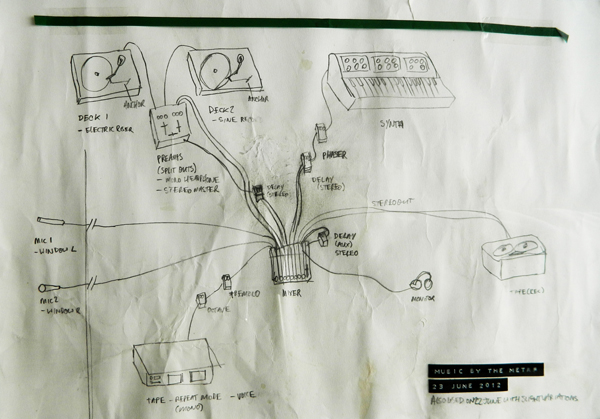
I’m currently reading Tilman Baumgärtel’s book on the history of the loop, Now and Forever. Apart from kicking myself I hadn’t got round to this during my PhD research (I may still mention it in my corrections) I’m enjoying it and getting a lot from it. Reading more detail about Pierre Schaeffer’s locked groove turntable experiments is fascinating – not only is it very relevant to my own work, particularly considering the turntable’s innate capacity for creating rhythmical loops, but also the clear descriptions of the processes from Schaeffer’s diary are really illuminating. And it’s a perfect example of the kind of self-perpetuating long-term project I’m thinking of. Beginning with experiments almost for their own sake, Schaeffer explored the materials, functions and affordances of the technology and the sounds themselves, following the flows and the signposts and just discovering along the way. Musique Concrète seems like such a well considered and perfectly formed approach and set of concepts that it must have been mapped out in advance, a lifetime’s work. But digging into the the processes at play and Schaefer’s contemporaneous self reflections shows the way in which it grew over time.
One thing I found difficult during the main part of the PhD study was trying to stay on track. When I’m feeling at my most creative I’ll have lots of ideas for kernels of projects or starting off points, often relating to a simple practical experiment, and have a strong urge to follow where they lead. Each has the potential to become a long-term project, though most won’t ever get past the testing phase. Now I’m close to submitting the final version of the thesis I’m looking forward to pulling on some of the threads I left behind.
 Graham Dunning
Pingback: Found Post-it notes in “The Thingness of Stuff” exhibition | Graham Dunning