Collaborators and London venues lists – mostly for me
I’ve updated the links page on the website today with two things: a list of most of the people I have collaborated with (and, in some cases, continue to work with) and a list of local venues I often go to.
As I move away from commercial social media, I’m trying to find ways to keep connections and networks visible and viable. The site doesn’t have a “blogroll” as such, but this serves as an alternative: a way to link through to people I’ve worked with and whose work I want to promote. I may add a little more info about each, a few words biography or description perhaps, but also want to try and keep things minimal. I expect I’ll also find this page useful for myself when mentioning people in posts and wanting to link through to their sites.
I put together the venues list for another reason. London is so busy with stuff happening that you have to get used to the sense of FOMO: you can’t see everything you want to, totally spoilt for choice, so have to pick your battles. Occasionally, like today, I find myself with a spare evening and want to find a gig or event to go to. There’s no centralised place for listings now – where I might once have browsed a paper copy of Time Out or, later, searched on facebook, I now find myself clicking through loads of individual venues’ and promoters’ listings to find events. Which is fine. The centralised platforms inevitably fill up with spam, rubbish you’ve no interest in, or miss out most underground stuff which doesn’t engage with it. This list of links is really for me to be able to find stuff quickly. I’ll endeavour to keep it updated. It may also be useful to point out-of-town visiting friends to when they’re looking for something (mainly why I included the location info on the venues list).
The intention of both lists is to be useful as a resource, mainly for myself but perhaps for one or two others too.
A new home for the Mammoth Beat Organ
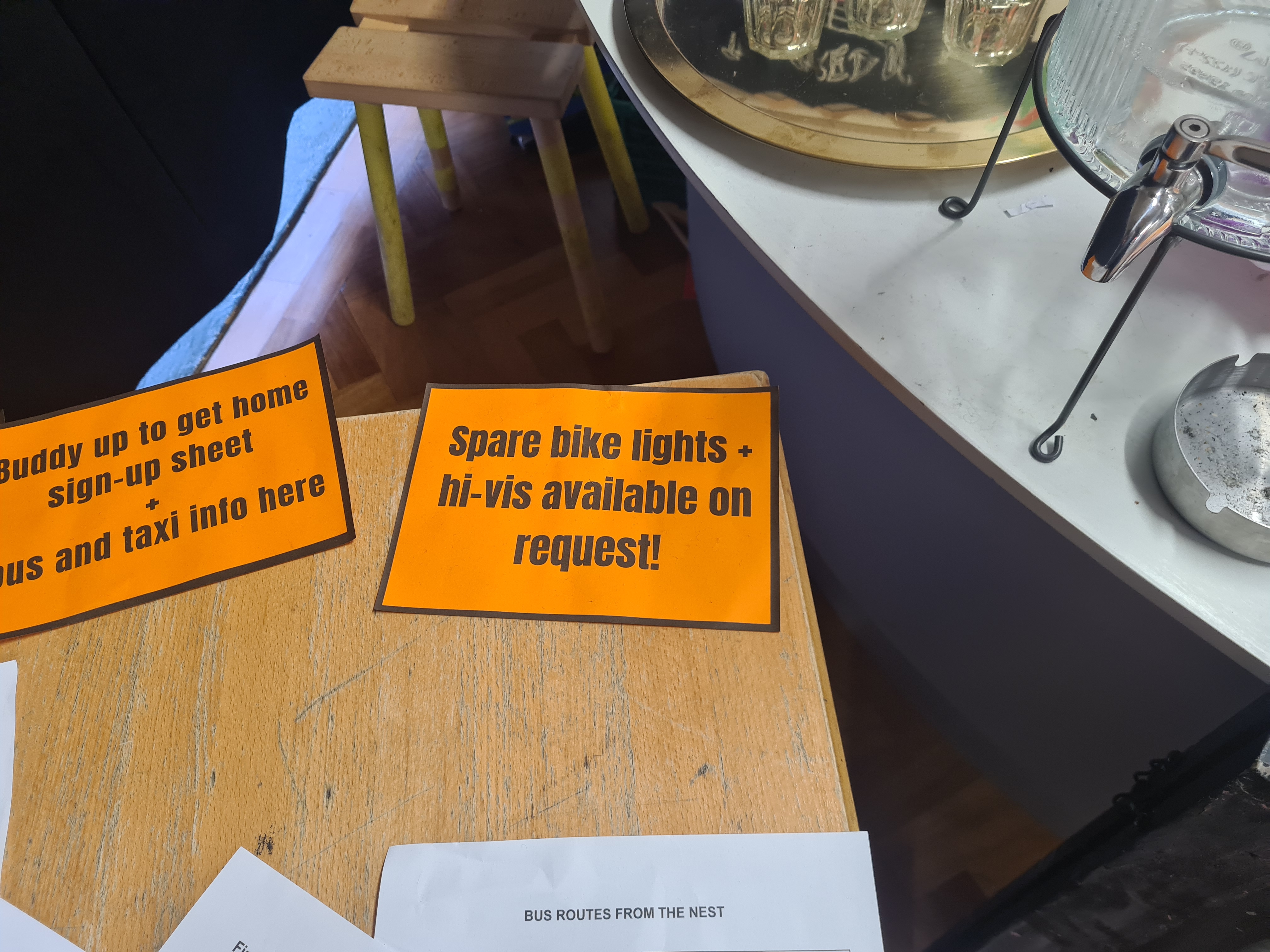
This weekend I visited The Nest in Oxford, which is the new home for the Mammoth Beat Organ, to show the custodians the ropes and make some mechanical noises. The Nest is a “wholly inclusive space for young people wanting to express themselves through music,” based centrally in Oxford in a formerly empty shop space and ran by YWMP. Since getting set up in the space in mid-2025 they’ve hosted over 30 gigs, plus weekly hangouts, various courses and recording sessions. They have an active Safer Spaces policy to encourage accessibility and engagement from people who are underrepresented in music, and evidence of this can be seen in the space, including very visible safety protocols and things like free bike light and hi-vis hire and lift-sharing so people can get home safely.
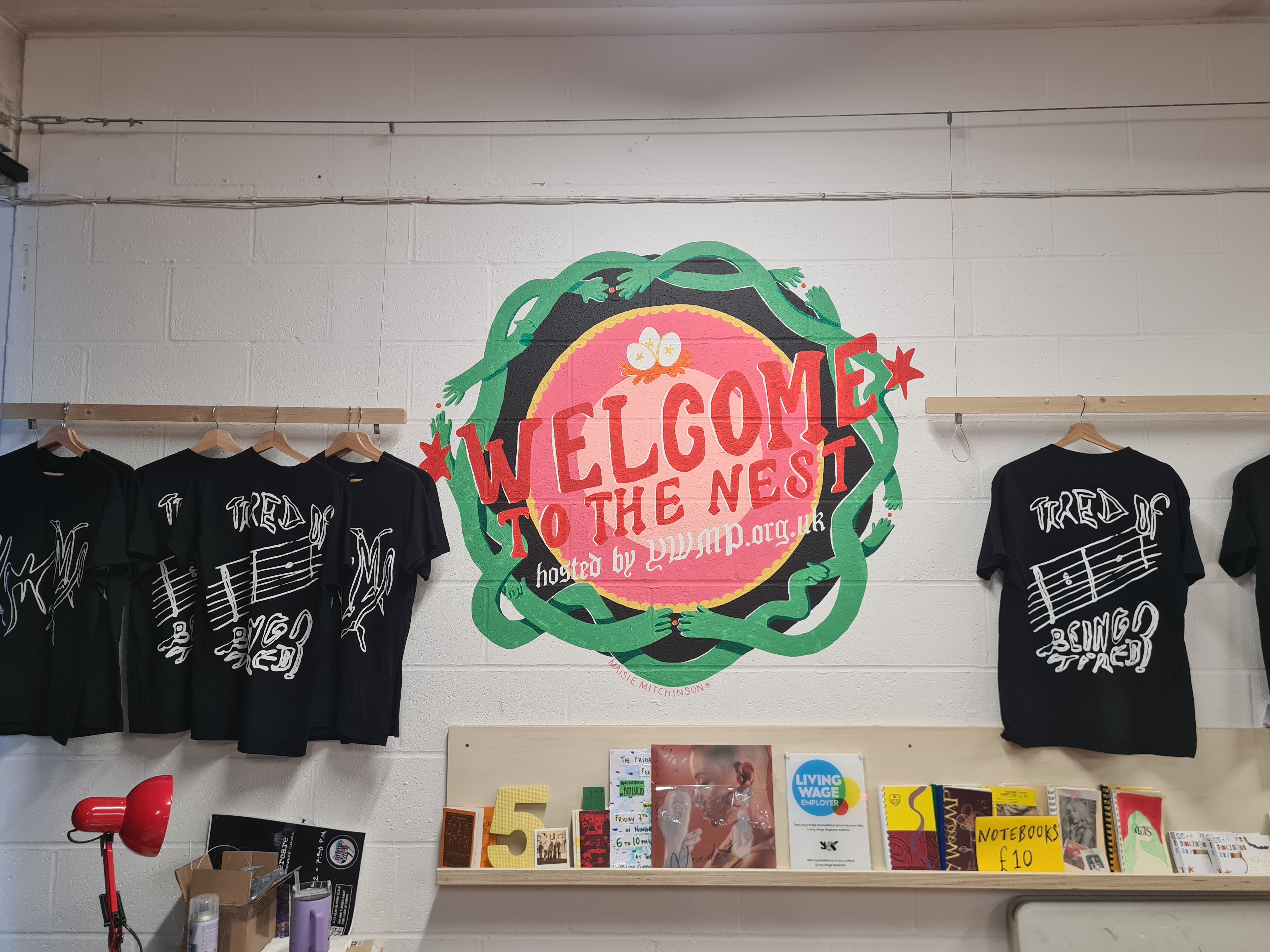
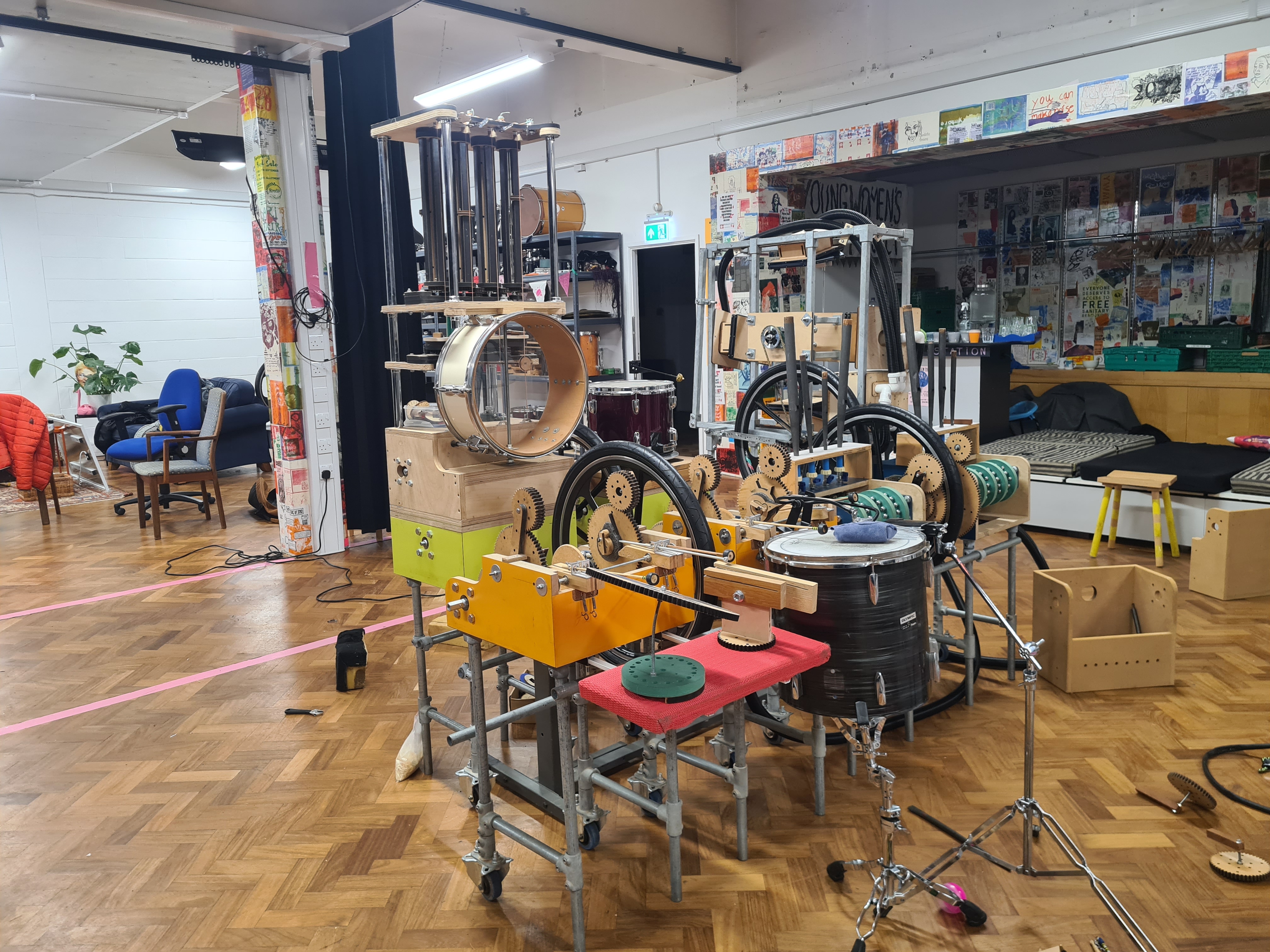
The Mammoth Beat Organ is a big mechanical musical instrument, it takes up a lot of space. It was formerly kept in Sam Underwood’s workshop where we built it together. Sam and Beck have recently sold their house and alll their belogings to travel the world by bicycle – you can follow their progress at bimblingbybike.com – so the MBO became homeless. YWMP are kindly looking after it, with the plan to get some young people using it to make beats, drones and scraping noises – exploring the world of experimental mechanical music.
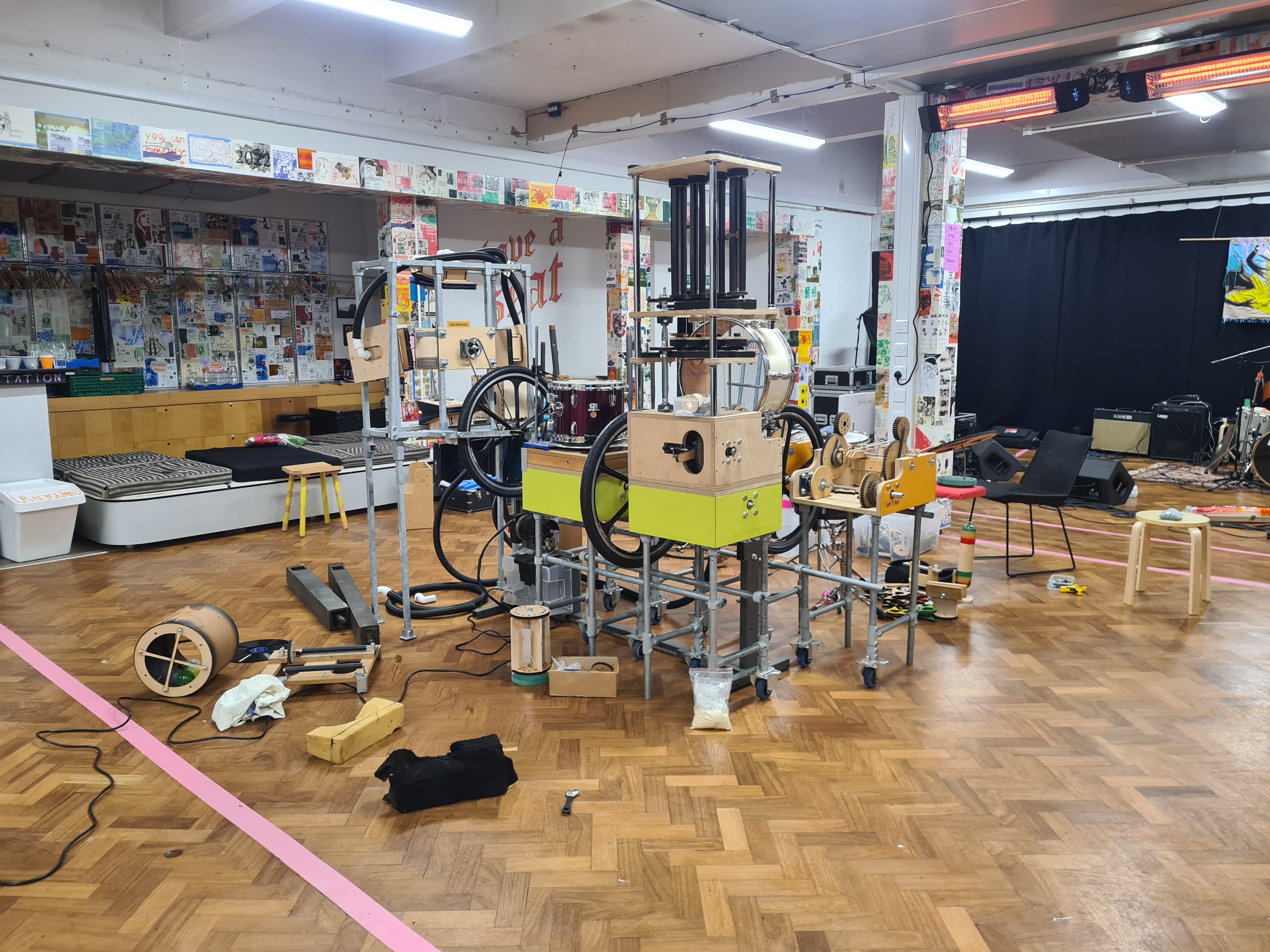
Me and two of the staff at The Nest started the day building the MBO. Though it’s big it’s designed to be somewhat portable, and various parts can be dismantled. Having assembled the parts and got everything in position we started the motor and everything was working fine. The drum module is possibly the most complex, with different gearing for different time signitures, a variety of cams in divisions of 4/8/16, 8 / 7 / 5 etc., and a load of different beaters to choose from. The air sequencer module has its own ideosyncracies too, and needs to be connected to the bellows (or a big pink balloon) in order to play. Swapping round organ pipes is a nice way to create variation in patterns, and as an unusual way of interacting with a sequencer is perhaps not the most intuitive way to play an instrument. The various noise makers – tombola, drone drum, rotating bin – on the utility module all required their own explanations. And finally the bass banjo with various different pluckers, hurdy-gurdy wheels and dampners.
I’ve got a few video clips to share which I’ll post here once I have time to edit them together. Hopefully the Nest crew will keep me updated with any future MBO activities, which I’ll share here too.
If I was going to write an end-of-year list, this would be it
Typically I enjoy logging things and keeping records. I track what films I’ve watched with Letterboxd. I have list of what fiction I’ve read, which I started in January 2022 in a notebook and recently switched to a spreadsheet. I track my running and climbing too. I find the accumulation of this kind of information satisfying in itself, but it also serves other purposes. For films I’ve watched, it’s a very practical thing. My memory is really not what it used to be and the list serves to remind me what I’ve actually seen. I’m working through the classic 40s and 50s film noirs, for example, and they do tend to blend into one. I’ll often refer to the list in in-person conversations if the topic of films comes up. Tracking fiction is similar, though I do tend to remember what I’ve read more readily than what I’ve watched. I sometimes refer to the list when I’m buying a new book to read, reminding myself about authors or series I’ve enjoyed. Or giving me a nudge to switch genres if I’m in a run of sci-fi. Tracking exercise is quite practical. My monthly climbing wall membership only makes sense if I go at least six times a month, so I started it to monitor that. Logging my running distance is a good motivator – I’m aiming to run one mega-meter (1000km) this year, and currently just need to get another 64km done in the next two weeks.
I have tried logging my music listening in the past, but found it wasn’t for me. My first encounter with algorithmic recommendations was via Last FM, a website which tracked your listening stats and compared this to other members. They invented the verb to “scrobble” for this, so new did they consider the concept. Scrobbling could be done via the website itself, which allowed for artists to upload their discography for streaming (feeling a bit like MySpace from an artist perspective, as I recall. Checking now seems like my artist profile is still there, though I’ve not thought to look at it for years now). Or via a plugin for your favourite media player. VLC player still has inbuilt settings to log your plays. I got quite into Last FM and scrobbling, and enjoyed seeing my stats. Some familiar issues occurred, like hour-long tracks counting as one play comparable in the numbers to listening to a two-minute song. I remember the recommendation algorithm being pretty good but fairly rudimentary, and not always useful in finding new artists. For example, anything rock-based would always generate the Beatles, Radiohead and Bowie in the top artists, however obscure the origin, just by the sheer weight of numbers those major artists would draw. But the reason I finally stopped was when I noticed my listening behaviour being affected by scrobbling. Putting a record on to listen to I hesitated because I realised it wouldn’t get added to my stats. I considered finding the mp3s and listening to the same album that way instead. With that I decided I needed to pull away from the scrobble.
I’ve listened to a couple of interviews with Liz Pelly this year, who has extensively researched the way Spotify works for her book Mood Machine (she was on No Tags podcast back in February and more recently Politics Theory Other), and find it fascinating the way in which the streaming platform has changed the way people listen. I’m not a playlist listener myself, preferring either complete albums (to get a feel of the artist’s bigger body of work) or DJ mixes (to feel how different tunes fit together in a considered way). My brief trial of Spotify ended quite briefly when it didn’t have anything by Om on there, and when the only version of a Joy Division album was a recent remaster which sounded completely different than the original. I understand the ubiquity of the platform but it wasn’t for me. Spotify focuses on the individual listener rather than the genre, scene or artist, tailoring playlists and recommendations to the listener’s sense of self rather than their connection with others. And the end-of-year stats it provides are part of that. I recoil slightly every time someone posts their Spotify Wrapped list – it doesn’t feel to me like a celebration of the music or a contribution to the community, it’s a celebration of their individual taste and a presentation of their personality.
I think the other factor that puts me off the Wrapped-style year-end review is the focus on the importance of the numbers. To a large degree I’m more interested in what’s new than revisiting music. I’m lucky that I get to put together a monthly radio show which gives me the impetus to go looking for new underground and experimental music. I can play anything I like on the show – there’s no pressure or direction whatsoever from the station – but I have some self-imposed guidelines that affect what I play. I try not to ever repeat tracks from show to show. I won’t usually play more than one track by the same artist in a show. And I try and find new artists to play as much as I can, avoiding over-playing the same people. This isn’t something I currently track, though I do have a spreadsheet for this, it’s jut not been updated for a couple of years. If I were to analyse the numbers for the listening that goes into making the show, there wouldn’t be clear trends with tracks or artists moving to the top of the list. Some of these I might only listen to a couple of times. Or it might take me a few listens to an album before I realise I’m not into it, potentially generating bigger numbers that don’t map onto my enjoyment of the work.
This blog post is inspired by a post on mastodon by C. Reider, describing their listening habits as somewhat incompatible with the concept of the year-end list. “i’m constantly listening to music that’s new to me, but not necessarily a lot of music that was released in the last 12 months. might make a big recommendation list of things i liked this year, but 90% of it will be not brand new.”
My own listening is somewhat similar. I don’t think I will make any formal recommendations, however, I kind of think the radio show is how I do that throughout the year (the tracklist for each show is on the blog and I think the bandcamp library page does a good job of showing most of what I’ve bought, despite the issues with it being a closed system).
I mostly listen to DJ mixes when I’m out running. This year I enjoyed digging into the archives of Field Maneuvers festival, with favourites from Jay Duncan, Ben Simms and Local Group. I also really like the live mixes posted by south London record shop Planet Wax on youtube, and highlights were by Louise Plus One and Jerome Hill. In terms of bigger numbers, the stuff I end up listening to often is also context dependent. I’m excited to be going to see Pharaoh Overlord live for the first time next year, so have been going back over their stuff and checking newer releases on their bandcamp page. Because I’m moving house soon I’ve been looking through my CDs and records, listening to some albums I’m less familiar with, which is one of the benefits of physical media. Similar to what C. Reider said, not everything I listen to is newly released, but often it’s new to me. All this is to say, I’m not writing an end-of-year list, but if I was, this would have been it.
What am I going to do after my PhD?
Having passed my viva with minor corrections this week, my PhD is pretty much in the bag (wahey!). I’m looking forward to sharing Mechanical Techno: Extended turntable as live assemblage with the world once I’ve made the last few changes. In the meantime, I shared the documentation of my show in Sheffield last year which forms the basis of chapter 4 of the thesis. You can watch it here.
Working on the write-up has taken most of 2025, and I’ve put off a lot of things I wanted to do in that time in order to get it written. No complaints, that was the job I needed to do, but I’m now looking forward to spending time doing some more fun stuff again. As such, after my viva I bought the new Dungeons & Dragons boxed set, which I’ll be running with some friends from January. And a load of sci-fi and hard-boiled detective fiction to read. Three events coincide this coming weekend and I hope to attend all three. Iklectik’s annual NOISEMAS celebration is a twelve hour show with back-to-back noise sets, featuring a lot of friends performing and no doubt many others in the audience. The last BRAK of the year, a regular free improv show where Cath Roberts, Colin Webster and Tom Ward each pair up in a new duo. Always a lovely meet-up with an overlapping group of folks. And Das Booty, a rave with DJs typically playing stuff from the harder and weirder end of techno, breaks, UKG and bass music – hoping to convince some of the noise crew to come along after.
Whilst I’ve been fully immersed in music making and thinking about music recently, I’ve missed going out to gigs as often as I normally would, and haven’t been playing much at all this year. The majority of my social life usually revolves around events like these and a main plan for me going forward is to get more involved again. That also means resurrecting the tape label Fractal Meat Cuts, and I’ve got a few exciting things in the pipeline for that. Generally my plan is also just making more stuff (music, instruments, other things), sharing what I’m doing and trying to connect more with people and the scene.
One change I plan to make in 2026 is coming off instagram, which has been on the cards for a while. My main concern has been losing connections with people, being less able to share what I’m doing and finding out what others are doing. I don’t want to go into all the reasons for disconnecting from corporate social media here, perhaps that will make another blog post, but I really want to try and see if it’s possible to do things in a different way. I find way these platforms shape the users (both contributors and consumers) quite insidious. My main plan is to try to make my online output sustainable (for me to do it without feeling under pressure to do so), accessible in the long term, formatted on my own terns and not to suit the algorithm, and fun to make and engage with. I also want to be able to build and sustain networks with people. In practical terms this is going to look like: more regular blog posts, starting the monthly email list again, staying engaged with Mastodon (loving the community already there), and collating video documentation on youtube (rather than just short clips on insta).
Consider this post, then, the first of many.
2 new compilation tracks, and 2025 releases round-up
I’ve got two new tracks out today, and thought this would be a good opportunity to round off my year’s recorded music outputs too. Today, Friday 5th December 2025 is the last “bandcamp Friday” of the year, where anything you spend on the site goes directly to the labels/bands without bandcamp taking a fee. I have two tunes out today on two different compilations.


Compassion through algorithms volume III is a digital compilation of tracks mostly by live coders, to generate funds for charities working in Palestine. My contribution is an edit of a Mechanical Techno studio jam. There are over 50 tracks on the comp running all sorts of electronic music genres, including techno, electro, breakcore, drone and noise. Priced at £1 or more, with buyers encouraged to donate whatever they can, all proceeds are donated equally between Medical Aid for Palestinians (MAP), working for the health and dignity of Palestinians living under occupation and as refugees [www.map.org.uk] and A M Qattan Foundation, supporting culture and arts in resisting systematic erasure of the Palestinian people [qattanfoundation.org].
Collapsing Tape: Experiments in Rupture and Repair is a compilation on cassette and download by Bristol based label Collapsing Drums. My track on here is from the duo with Sam Underwood, where we combined my extended turntable with Sam’s acoustic modular system to create some clattering and wonky rhythmic electroacoustic music. The piece is an edit from our performance at LineUp! Festival in Malvern last year, which also features in chapter 6 of my PhD. The design of the tape is lovely and the rest of the tracks are great too, including some of my favourite noisemakers like Mariam Rezaei, Valentina Magaletti, Sculpture and Mr AKA Amazing.

I had two other releases earlier in the year too which are both available online. Some recordings from the RMA Study Group, Music and/as Process were released by the label associated with Birmingham Conservatoire, where the conference took place in 2024. Unusually for a multi-day academic event, us attendees were encouraged to bring instruments along, and the paper presentations were interspersed with both performances and opportunities for us to make music together. This album collates some of those sessions, including “directed improvisations led by Alistair Zaldua, whose ensemble line-ups were chosen at random, allowing for a fresh and dynamic approach to music-making. The album also features performances of contemporary works: Critical Mass (2023) by Steve Gisby, Post-card Sized Pieces (2020) by Sophie Stone, and What Is Left If We Aren’t The World (2021/22) by Emmanuelle Waeckerlé.” The album came out in June 2025, and you can download it here.
I worked with longstanding collaborator Sascha Brosamer on a new pair of recordings in late 2022, when we toured together and did some recording at my uni. Telescope/Microscope was released on Total Silence, Sascha’s label for new music and conceptual art, in August 2025. One of the pieces is expansive, cosmic and psychedelic, featuring extensive use of guitar, synths, and textural sounds. The other is more introspective and focused on phonomanipulation, noise and a monochromatic, minimal palate. Both use lots of turntable (me) and gramophone (Sascha) and many discs from our respective collections of field recordings, machine noise and other unusual documentary sound. You can download the album here. We have some exciting stuff in the pipeline, with our work featuring in a documentary about architectural history, and a performance for the gallery debut of that work in Berlin in 2026.
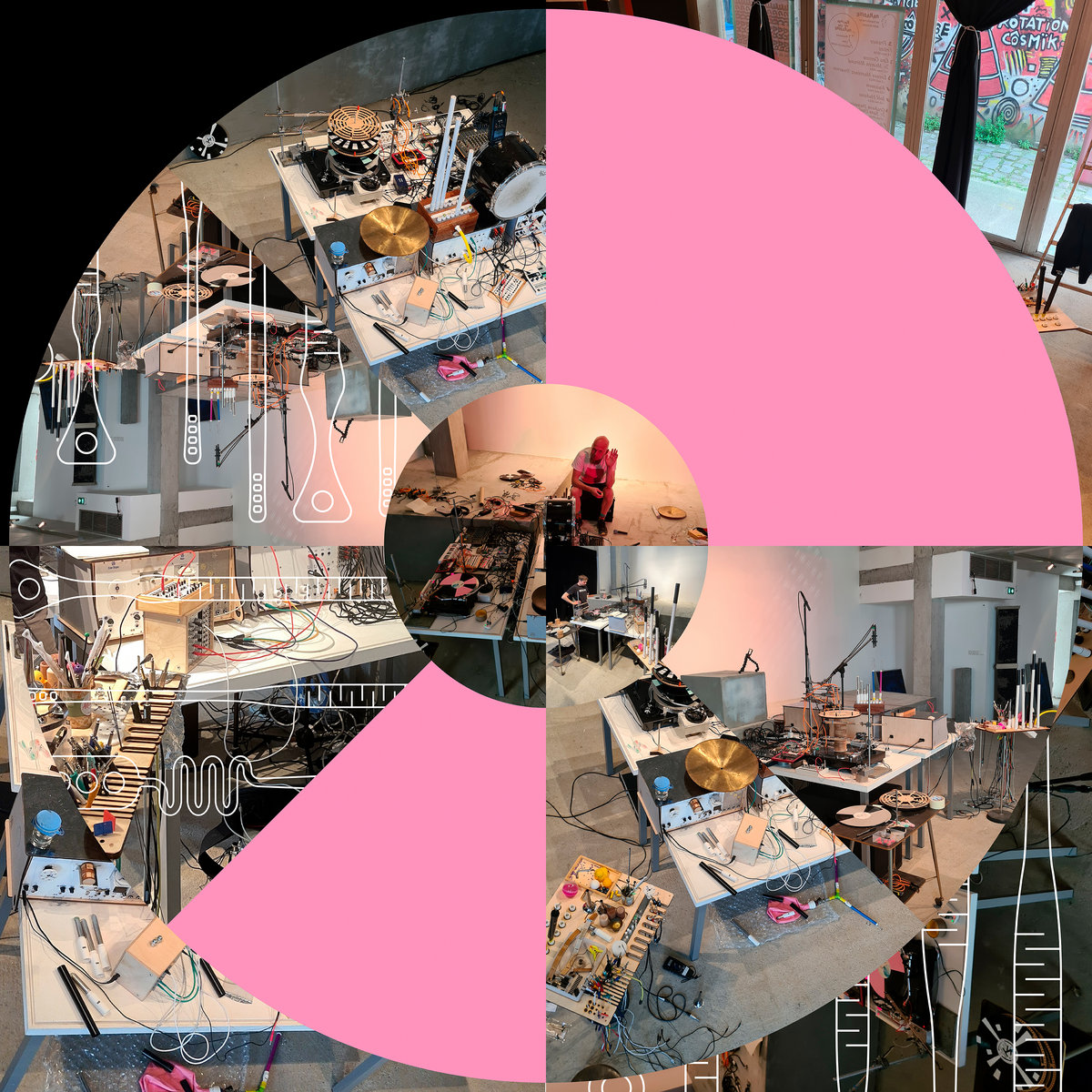
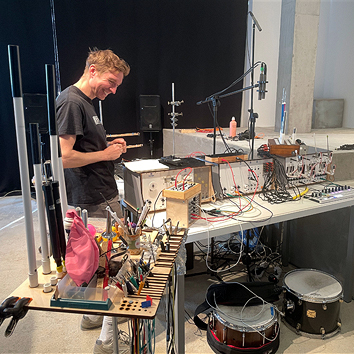
Finally it’s the anniversary of the release of Beaux Timbres, the album me and Sam Underwood released last year with Accidental Editions. This also features in the PhD, and it’s been great going back over the project to write about it over the last few months. The label still has copies of the vinyl and special edition modified record, as well as the download. All available here.
Lots more to come in 2026. I’m also planning to post here more as I’ll stop using instagram and need some way to promote what I’ve been doing! Stay tuned.
Noise in dub techno and as a textural sound source
Last week I came across a paper by Bahadırhan Koçer, Noise as a Spectre in Dub Techno, which I was excited to read as it resonates with my interests and current reading for the PhD. I made a youtube playlist of 48 of the 50 tracks Koçer mentions in the paper, which makes for an enjoyable overview of the genre across 20 years, tied together through use of noise as a compositional element in each piece.
Ghostliness and the spectral have deep associations with dub music already, with one of the proposed etymologies for ‘dub’ relating to the Jamaican patois term ‘duppy’ for a ghost or wandering spirit. Lee Scratch Perrry has described dub as ‘the ghost in me coming out’; there’s something necromantic about making music from recorded sound (like Edison’s capturing of the voices of the dead). Dub’s sound to me is both cosmic and earthly: the spaces it conjures through delay, reverb, hiss and disembodied/truncated vocalisations are fictions, virtual spaces of the imagination. Grubby and grotty like the scarier side of an acid trip, tangled in rainbow-glinting cobwebs. For me, the hiss and noise of 70s dub is an essential element as much as the more deliberate sonic effects. It’s not just the repetition of the delay, but the way it distorts with each filtered repeat. Turn up the decay.
The main argument of Koçer’s paper is to bring dub techno under the hauntology umbrella, through the use of various noise sources to reflect themes of urban decay, lost futures and the spectre of the past resurected. It’s clear there’s similar stuff going on with dub techno to Mark Fisher’s favourites Burial and The Caretaker. The origin for the inclusion of noise, according to the interviews cited by Koçer seems (appropriately) more organic and less of a deliberate reference, basically arising from the use of analogue audio equipment in some of the early pieces which laid the groundwork for defining the genre. Later examples use elements of noise in a much more conscious way, as the textural aspect became a key signifier of the genre.
Koçer’s knowledge of and enthusiasm for the genre comes across throughout, nonmoreso in the playlist table which lists a type of noise used within each track. I was pariculaly interested in the choice of classifications, including ‘static’ for types of tape hiss, record crackle, and identifying various field recordings as noise. I’ve been thinking about ways in which noise can be tapped as a textural element, the extent to which process matters (VST tape plugins vs actually recording to tape), Fisher’s writing on record crackle coming from sampled audio, and whether these sounds included deliberately in a composition can still even be called ‘noise’ at all. Every sound in a recording signifies something, and the way it’s treated can potentially clarify or obscure the processes used, the artist’s intentions and the context of the rest of the elements.
Lots to think over, for now I’m enjoying digging into the music.
Links:
Paper: https://dj.dancecult.net/index.php/dancecult/article/view/1251
Playlist: https://youtube.com/playlist?list=PLe81Xpl55VG4qF71OPw1PuhoIqeuAZqmA
Improvising with Machines case study: Mechanical Techno
The recent article for Organised Sound myself and Adam Parkinson wrote changed significantly from its first draft, which was weighted heavily towards case studies of our individual electronic music practices. Below is my case study, which describes one section of a typical live performance with the Mechanical Techno extended turntable setup.
In my Mechanical Techno project I use a standard DJ turntable as the basis for a spinning stack of modified vinyl records, each of which generates or triggers sound in a variety of ways. During live performances, each layer of the tower is added sequentially, separated by wooden cylinders skewered onto a knitting needle, as the whole structure continues to spin. As each new record is introduced a new musical component is added into the mix. The building of the stack dictates the structure of the music, but within that structure are various degrees of improvisation. The tower can be built in different ways using different combinations of components, modified records, external sound sources and effects. These can be combined in endless, unquantised ways.
The music made with this setup, whilst not always ‘techno’ by strict genre definitions, is repetitive, rhythmical, usually in 4/4 time and at between 122 and 144 bpm. In addition to a regular turntable tone-arm and cartridge, extended sound sources include analogue and digital synthesisers, small objects and acoustic percussion amplified with microphones, external sounds (eg radio static, oscillators or noise generators) amplitude- or filter- modulated by the system, and a range of unusual triggers and control mechanisms.
As soon as at least one of the sound sources is introduced, the platter will turn and sound will be produced: “it runs”. Intervention is always possible and might include changing the speed of the platter; repositioning tone-arms, triggers or controllers; introducing auxiliary effects or changing their settings; or nudging the angular position of records in relation to one another (thereby changing rhythmical relationships).
A typical configuration of part of a live performance might comprise the following:
Layer 0 (on the turntable platter itself): a 12″ white label of unidentified dance music, blanked off in alternate quarters with adhesive vinyl of the type used for graphics or signage on shop windows. An ordinary turntable cartridge is used, but the tone-arm is constrained in its lateral position by a piece of thread tied to a weight, positioned on the platform of the turntable. Each time a covered quarter of the record passes the needle, slight surface noise is heard but no other sound. On alternating sections, where the original vinyl is exposed, a snippet of audio is played back – a physically selected sample. Unless the original recording is at exactly 133 ⅓ bpm (or 90 or 180 bpm for a record intended to be played at 45rpm), the tempo will not match the rotation of the platter, and may or may not be in sync with the perceived rhythm. Additionally, the adhesive stickers themselves produce audible clicks which, due to their 90 degree separation, can emphasise the 4/4 beat. The grooves of the record are microscopically close together and, despite the thread, there is some potential for lateral movement of the stylus each time a blank part of the record passes. As such the needle sometimes jumps into a different groove of the record, playing a different sample in an unpredictable way, but forced into the same rhythm by the regular placement of the stickers: “it surprises” as physical wobbles of the turntable increase the likelihood of change.
Layer 1, 50mm above the first positioned on a wooded cylinder: another modified record, this time a smooth disk of vinyl, the unpressed B-side to a single-sided release. A line of scratches bisects the disk, around which sandpaper has been used to roughen the surface. A standard turntable cartridge is attached to a second tone arm, held in position to allow the needle to read the vertically raised disk. Twice each cycle, the roughly scratched section passes the needle and emits a burst of harsh, scraping noise. EQ settings on the desk and a short reverb shape the sound into something approaching an electronic handclap. The smooth parts of the record are not perfectly noiseless and sometimes sharp percussive clicks encroach on the rhythm. Over the course of a performance, the needle covers the same terrain hundreds of times, sometimes beginning to cut its own groove into the surface, and adding extra surface noise over time – “it evolves” to become noisier, and indeed no two rotations produce exactly the same pattern of noises.
Layer 2: A 300mm diameter disk made of 12mm MDF, laser cut with a regular pattern of 48 holes around its edge. Pegs are inserted into the holes to programme a rhythmical pattern. These holes are positioned to afford sixteenth note triplets. A contact microphone is attached to a wooden stick, held in position by a retort stand so that each time a peg passes, it flicks the piezo disk. The signal is fed to a Nord Drum electronic drum brain, triggering a digital (analogue modelling) kick drum sound. As the disk is now 10 cm above the platter of the turntable, and the faces of the wooden cylinders are neither perfectly flat nor completely parallel, some lateral and vertical wobble is apparent in the disk. Though at the trigger end this only translates to millimetres of variation, this can be enough to subtly change how the trigger responds: occasionally missing it, double-tapping, lightly brushing or playing earlier or later than in rigid metre – “it malfunctions” albeit in a minor way, the rhythm generated is imprecise and off-grid, microtiming variations affecting the groove in something akin to the difference between a drum machine and a live drummer playing the same pattern.
Layer 3: an optical reflection sensor, built for me by Tom Richards, reads white stickers placed on a standard vinyl record in programmed patterns. The sensor is a binary switch, sending a 5v control signal each time a sticker passes. The signal is sent to the gate input of an Arturia Micro Brute analogue synth with an internal sequencer. An independent LFO can vary the timbre of the resulting bass part over time. I have many different pattern disks to choose from, and each can have several ‘tracks’ of patterns, arranged around concentric circles on the disk, meaning they can be selected in real-time by changing the position of the tone arm. Part of the improvisation here is in choosing which disk to use, selecting which pattern from the disk, and also varying the relative rotational angle of the disk with relation to the existing rhythms. It’s something like using several step sequencers, all set to the same tempo but with non-quantised start-points. Additionally, the ‘locking’ of the synchronisation is dependent on the friction between the disks and the wooden blocks which separate them. It’s entirely possible that drag from one of the sensors or tone arms can shift the start point and therefore the rhythmical timing between each of the disks. Certain of the disks for the optical reflection sensor use divisions of eighth or sixteenth notes, but others use twelfths, divisions of ten or more random patterns (such as a series made from tracing irregular shapes from diagrams of bacteria). Whilst with practice it is possible to guess approximate rhythms by looking at the disks, in the moment of performance this is often a surprise. The sequencer on the Micro Brute can be programmed in real time. Each gate signal advances the sequence by one step, and the sequence can be anything between 1 and 64 steps long. As such, the number of triggers per cycle need not match the number of steps per sequence, and setting sequences which phase in and out of sync with the turntable’s loop point is simple and intuitive. These kinds of phasing patterns are not always predictable during programming, and can even change again if single steps are missed due to read errors – “it plays”, creating basslines, riffs and melodies which would be very difficult to accurately predict or plan for.
Layers 4 and 5 introduce more percussion sounds using the trigger methods above, playing another voice on the Nord Drum and using a second optical sensor to activate the clock of a Volca Sample sequencer loaded with percussion sounds. With each additional layer, the tower becomes slightly more precarious. Additional layers introduce more severe microtiming variations, asymmetric time-divisions due to the physical wobbling, friction and vibration which can affect other layers already in play.
Layer 6 is a wooden disk with evenly spaced pegs around its edge, each pair joined by an elastic band. Two piezo sensors dangle by wires over the disk, close to the edge but clearing the pegs. The sounds each make are tuned electronic percussion, somewhat like a thongophone or a donk (the electronic sound which gives that genre its name). Several ping-pong balls are introduced one at a time, rolling round on the platter and creating a random rhythm distinct from the more regular patterns the rest of the machine is producing. Physically flicking the ping-pong balls at the triggers changes the patterns. Whilst the pattern at first appears completely random, the diameter of the balls is such that the spacing between each when they are immediately adjacent is close to a sixteenth note at the edge of the disk. As such, bursts of donk rhythms can sound in time with the beat. The physicality of the setup is what gives the rhythm its character. The tension between randomness and regularity can feel like the machine is soloing on its two donk notes.
Working with the mechanical techno setup can feel like a collaboration with another entity, from my perspective as a performer, “it collaborates”. The available options – sample records, pattern records, trigger patterns, synth parameters – can be combined in endless configurations. But each time I make a decision it closes off certain other options. It feels as though the machine is limiting my choices at each stage. I think of the process of making a piece as one of optimisation, similar to a funk band ‘locking in’ to the groove of a track. Danielsen describes this kind of process giving an example of a James Brown funk track.
“For this reason it would be better to call it optimization than variation – optimisation of the different elements so that they become even more integrated and comfortable within the whole. This continuous optimization is often described as ‘locking’ or ‘nailing the rhythm.’ It is not a carefully considered process, and it never really ends; instead, it goes on automatically, continuously, manifesting in the form of better or worse periods of interaction.” (Danielsen 2018, p41)
Once a groove is up and running, my role can vary depending on how I view the pacing of the performance. Repetition is in the nature of electronic dance music, so allowing the machine to run is a valid performance decision: I can stand back and let the rhythm play for several bars and allow it to have its say. For me there is enough variation in microtiming, evolving noisebed, irregular and unexpected minor changes in timbre, timing and sample selection that the loop is never static.
Chris Cutler criticises the unchanging repetition of recorded loops: “Where biological systems are creative and unreliable – qualities which I believe are profoundly linked – mechanical or electronic systems are unerringly accurate, but mindless.” (Cutler 2018, p68) His defence of human-played repetitive music revolves around the players’ inconsistencies: “There may be endless repetitions in aural cultures, but there can never be loops because, as long as human agency is involved, the same thing is always going to be different.” (Cutler 2018, p68) My system, through its unreliability and fallibility, creates loops which are consistently variable, creating a groove with more character than an unchanging repetition.
Cutler, Chris (2018). Loops, Memories and Meanings, in Julien, O and Levaux, C (Eds.) Over and Over: Exploring Repetition in Popular Music. London: Bloomsbury Academic, pp 68-74.
Danielsen, Anne (2018). Time and Time Again: Repetition and Difference in Repetitive Music, in Julien, O and Levaux, C (Eds.) Over and Over: Exploring Repetition in Popular Music. London: Bloomsbury Academic, pp 37-50.
Improvising with Machines: A taxonomy of musical interactions, by Adam Parkinson and Graham Dunning
An article written by myself and one of my PhD supervisors, Dr Adam Parkinson, was published today by the journal Organised Sound. The paper is open access and you can read it here: https://doi.org/10.1017/S1355771824000268
This article maps out some of the relationships between performers and their instruments in live and improvised electronic music. In these practices, musical machines – be they computers, mechanical assemblages or combinations of different sound-makers and processors – act as generators of musical material and sources of unpredictability with which to improvise. As a lens through which to consider these practices, we examine a number of different roles these musical machines may take on during improvised performances. These include running, playing, surprising, evolving, malfunctioning, collaborating and learning. We explore the values of these different roles to the improvising musician, and contextualise them within some broad and historical trends of contemporary music. Finally, we consider how this taxonomy may make us more open to the vital materialism of musical instruments, and offer novel insights into the flows of agency and interaction possibilities in technologically mediated musical practices.
We began writing the paper almost exactly one year ago, so it’s great to finally see it out in the world. This is the first paper I’ve had published by an academic journal, so something of a milestone for me. If you have any thoughts or comments about it, I’d love to hear them.
Home made modular synth cases
As I’ve built and acquired more Eurorack modules I’ve been slowly working towards a setup which doesn’t require much additional outboard gear. I’ve upgraded a bit at a time and ended up with four small cases. A couple of problems have arisen from this. First, that some of the modules are too deep to fit in certain spaces, so I’ve had to locate them in places which aren’t intuitive to use or particularly convenient. And second, that using separate cases means I can’t really pre-patch anything before a gig, so setting up is long, complicated and stressful.
The last show I played was with DJ Food at Levitation Festival (short clip here) and I knew we would only have a short turnaround before going on stage. So I trialled putting three of the units into a flight case so I could pre-patch and save some time. It worked pretty well.

Taking this as a practice run I decided it would be worthwhile to turn this into a more long term solution and build a box to house the modules in. I’d already made a couple of small cases for the deeper modules in my collection, which used 4mm MDF and extruded aluminium rails. So I knew the basic principle would work, and just needed to make them. Here’s one of the smaller cases, which I’ve just recently spray painted. These are the modules I’ve designed recently which all use an Arduino so just take a 5V power input. That is, apart from the Motor module which has its own 12V supply. I added the air vents to the sides primarily for the Motor module, which has some pretty big heat-sinks on the drivers. The 4mm square holes leave enough material for the sides to be rigid too.
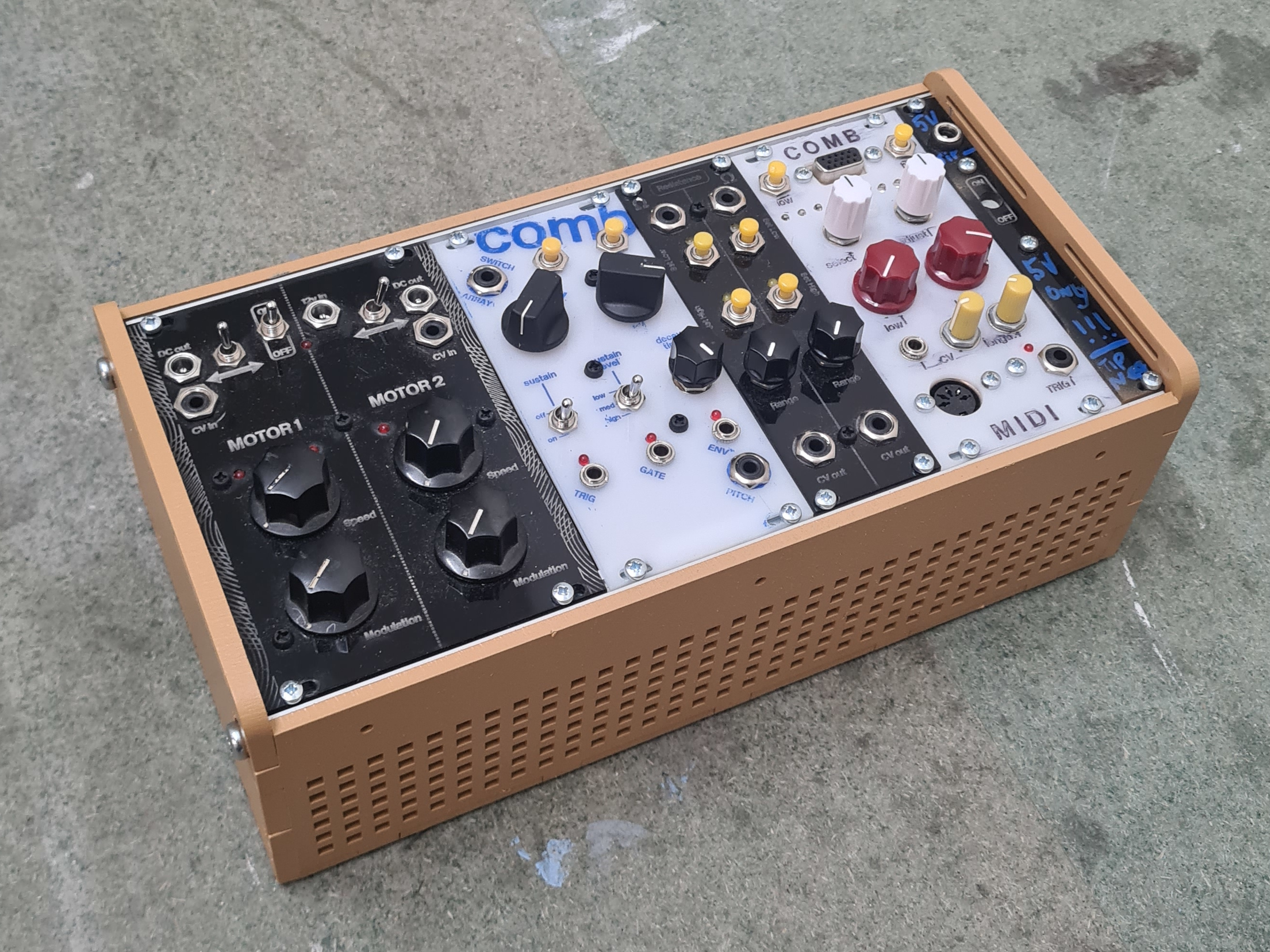
The initial plan for the new one was to make a case which would be the same dimensions as a Technics SL-1200 turntable, for the primary reason that I have a ‘deck saver’ plastic lid which I don’t use, which would make a good lid for the unit for transporting the pre-patched modules. Testing a couple of orientations, the most efficient way seemed to be orientating it portrait-wise which would give three 69hp rows of 3U rackspace and one row of 1U. Surprisingly and serendipitously, using 4mm material this fits EXACTLY to the millimetre. The clearance of the unit allows for my deepest modules (Doepfer A-103 filters at over 50mm) to comfortably fit with some room for cabling, meaning no more awkward decisions about which module to put in an inconvenient place. I’m pleased with the outcome apart from the fact I made it very slightly too wide to fit the deck saver lid – somewhere in the design I added 4mm to the width, annoyingly. Not enough of an issue to re-cut though.

The other main intention with this build was to try to save money buying something off-the-peg. I’m fairly sure I have done that – fully made cases this size are wildly expensive – but this wasn’t cheap to make by any means, as there are lots of components apart from the case:
- Rails are extruded aluminium as sold by Synth Racks in the UK [link]
The case holds 69hp per row, so 8 pairs are required. I bought some of their old stock cheaply on ebay, which needed cutting to size and re-joining per strip. You can use M5 threaded rod to join two pieces. The end bolts are M5 too. The aluminium is soft enough that you can bolt into the cut end without needing to thread it. - Power for the whole case is a 2MS Row Power 45 module. It seems great so far, and should have enough wattage to run the modules I have. It’s not cheap though – and you need to buy both the power supply and cable for it extra!
- For power distribution I bought some ‘flying bus cables’ from Thonk. [link] The Row Power has two sockets and I daisy-chained the third. I still didn’t have enough sockets so made some passive bus boards from vero-board and 16-pin sockets, like the ones below but longer. To be honest it doesn’t feel ideal daisy-chaining them like this, but according to the Row Power user manual this is a legitimate way to do it.
- Finally spray paint. I’m not a huge fan of bare MDF with laser scorch marks, though I do have a lot of stuff like that mainly due laziness in not painting it. I bought cheap furniture primer from the local pound shop and then used some good quality spraypaint to finish. The reason for the unusual colours is that someone in my studios was offloading a bunch of half-used cans.

A couple of folks have asked for the vector files for these cases, which is the main reason for this post. Here they are as vector files:
Small case vector file (svg)
Large case vector file (svg)
If you end up making one of them, please let me know how you get on!

Musical interfaces marathon – NIME ’24 day 1
This week I’m at the NIME conference in Utrech – New Interfaces for Musical Expression. I’ve had a busy few months with gigging, conference presentations and co-writing a paper, so not had the energy or inclination to keep up to date with blogging. But after a couple of conversations yesterday about the benefits of regular informal writing and and posting, I’m back again with a few notes from the conference. These are accumlated thoughts, points of reference and idea-seeds rather than particualry well formulated notes. Presented here roughly in chronological order.
(as of date of wrting the papers aren’t publically available, I’ll add links later to access them)
Excellent to see Christian Faubel perform live with his piece titled “songs from my analogue utopia”. The setup is a series of tiny actuators flicking stretched elastic bands, which are amplified with contact mics. The whole array is set up on an overhead projector giving a zero-latency real-time projection of each individual percussive strike. The osciallating motors are triggered by analogue clock signals from a modular synth. I’ve come across some of Christian’s writing about entrainment of oscillators previously – so there may have been some of that going on. Clocks were running in and out of phase, generating interesting polyrhthyms with the delicate but rich pings. Great to see the processes up close, as we were invited as an audience to gather round for the set.

Also glad to watch Dylan Beattie perform live, my first experience in a concert setting having visited his studio previously.
Impressed Dylan brought 60kg of vinyl lathe equipment across on the train! His set featured real-time cutting of grooves into vinyl dubs, using a handheld homemade stylus/tattoo gun. Some great textures and serendipitous moments. I liked the liveness of the set, with certain abrupt drop-outs and dynamic changes which belied the intricate and fragile nature of the process.
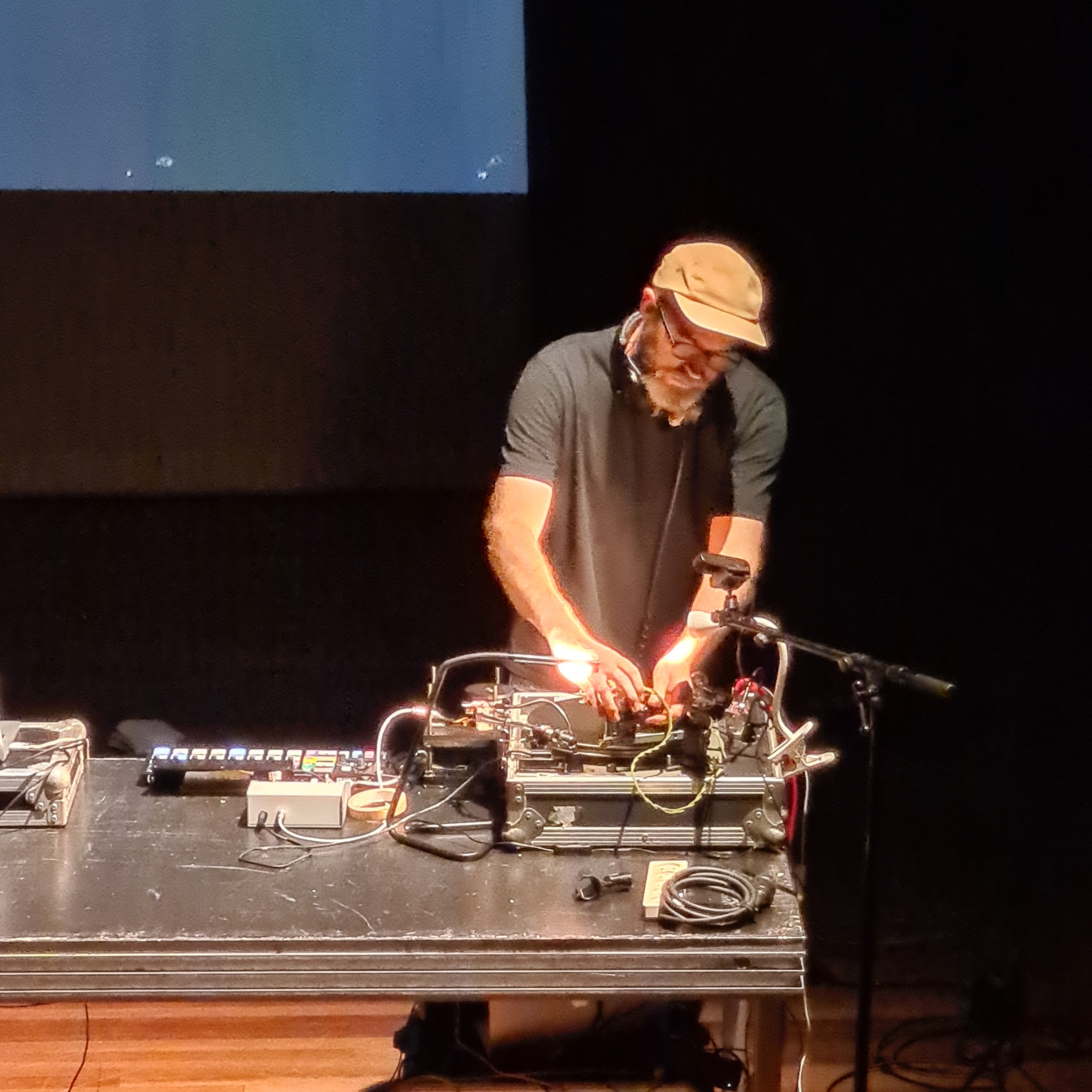
Zeynep Özcan & Anıl Çamcı gave a really interesting paper on use of juggling with physical-digital interfaces. Neither of these are particularly areas of interest for me but the parallels between the rhythms and cycles of juggling and those of musical rhythms and loops were intriguing. The research involved voicing three juggling balls in different ways, with sensors responding to accelration, jerk and impact, and each of the balls given a specific different sounding voice. Of most interest was the discussion of failure – neither of the paper’s authors were experienced jugglers and, as such, their attempts at testing the interfaces involved many drops, fubmles, clashing and impacts which skilled jugglers would not incur. As their reserach progressed their juggling skills also improved – but they found the musical ouput of the devices became less interesting. They began to deliberately fail sometimes, dropping balls on purpose, acting out errors, reverting to less-skilled behaviour in order to reintegrate the more interesting musical gestures. “Feigning mistakes to retain some of the sonic affordances of failure,” to quote the paper. This isn’t something i’ve come across before, something to think about further.
You can now watch the paper presentation/video here:
I also gave my own paper on Wednesday morning, titled Ironing In The Creases: Developing An Idiosyncratic Electro-mechanical Musical Instrument By Reinforcing Its Faults. My intention was to talk about my making process and how it works in a cycle, including the key decision points where I acknowledge the aspects of a new development which are causing problems or issues, which can also potentially be benefits or produce interesting musical effects. My paper ended up being quite long, as I wanted to include lots of contextual information about thinking relating to the process, and also needed to establish some of the precedents and context for the project itself. Neeless to say it was tricky then to get it all into the 10 minutes allocated for the presentation. There’s a video version here which is essentially the same as what I presented:
I had some good feedback from other attendees including some questions that got me thinking. Responding to one question in the room I mentioned that I had some personal rules or an unwritten manifesto which had been guiding the project. I’ve never formally written this out, but have started to make notes towards doing so for myself.
Specifically these are things like:
- No direct playing. All sounds are played by the machine: I wouldn’t, for example, set up a beat and then do a synth solo over the top.
- No backing track. This has been a rule of mine for so long it’s second nature. Performing along to a linear recording restricts the option for pacing, live arranging the material, which is fundamental to any performance for me.
I’m not going to write them all out here, just a couple of points by way of illustration.
At the first evening concert, John Bowers played a few short sets using some strategies developed with Robin Foster around rummaging with various digital and algorithmic augmentations. The weird little garage unit at the venue gave it a classic noise gig vibe which worked realy well. Part of John’s approach is running several different mappings from the sensor inputs concurrently, then mixing between the outputs. This creates a system which is both responsive and playable, with seemingly infinite variation available.
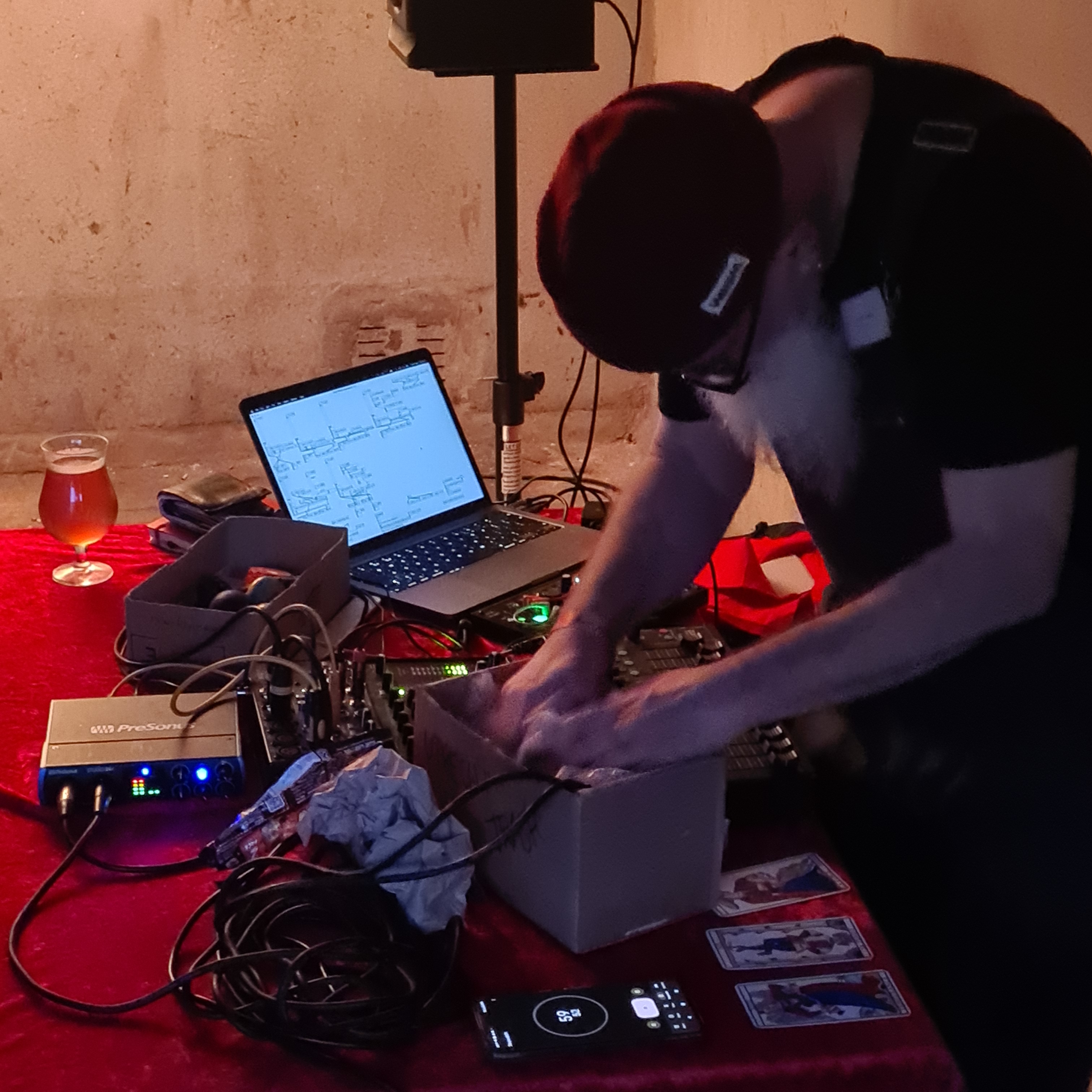
An intense finish to the day came from Transsonic (Viola Yip/Nicola Hein) who played an absolutely searing noise set with handheld lasers and an integrated system of sound controller and distorted guitar. A dark room with only red lasers to provide light, I couln’t see quite what was happening – but the responsivity was apparent and the soundscape flitting around the powerful club system worked amazingly well.
Here’s a video version of their performance, submitted prior to the conference as far as I’m aware – play it loud!
The days are long and intense at NIME. The first day’s programme started at 9am and finished at 11pm. I think I counted about 16 papers and 12 performances I’d seen during the day, plus all the poster presentations and demos. So, necessarily this is just a sample of the highlights. I’ll likely post more later in the week, depending if I run out of energy beforehand. Luckily most of the venues here sell Club Mate.

